


DEFENSIVE DATING
Not paranoid. Prepared.
You do not need proof that someone is dangerous before you protect yourself.
Check the warning signs →
Something already feels wrong?
Plan a Safer Date
You cannot control another person’s choices, but you can give yourself more options, more information, and an easier way to leave.
1. Choose the location
Meet somewhere public, familiar, and easy to leave.
Choose a place with:
Other people nearby
Staff on site
Reliable phone service
More than one exit
Transportation available nearby
Avoid changing locations just because your date pressures you to.
2. Control your own ride
Whenever possible, arrange your own transportation there and home.
Do not rely on your date for your only ride.
Keep enough money, battery power, transportation credit, or fuel to leave independently.
3. Tell one trusted person
Send someone you trust:
The name or profile of the person you are meeting
The meeting location
Your expected start and end time
How you are getting home
When they should expect to hear from you
You can also share a screenshot of the dating profile.
4. Set a check-in
Choose a time to message your trusted person.
Agree on:
A check-in time
A code word or emoji
What they should do if you miss the check-in
Whether they should call you, come get you, or contact emergency services
Example:
Green heart: Everything is okay.
Red heart: Call me with an excuse to leave.
Black heart: I need immediate help.
5. Protect personal information
Before meeting, consider what the person knows about:
Your home address
Your workplace
Your children’s school
Your regular routine
Your vehicle or licence plate
Your live location
You do not owe anyone your address, passwords, location, workplace, or private information to prove that you trust them.
6. Keep your exit easy
Keep your phone charged and accessible.
Sit somewhere you can leave without being blocked in.
Keep your coat, keys, medication, and belongings close.
Do not leave a drink unattended.
You are allowed to leave without finishing the date, explaining yourself, or protecting someone else’s feelings.
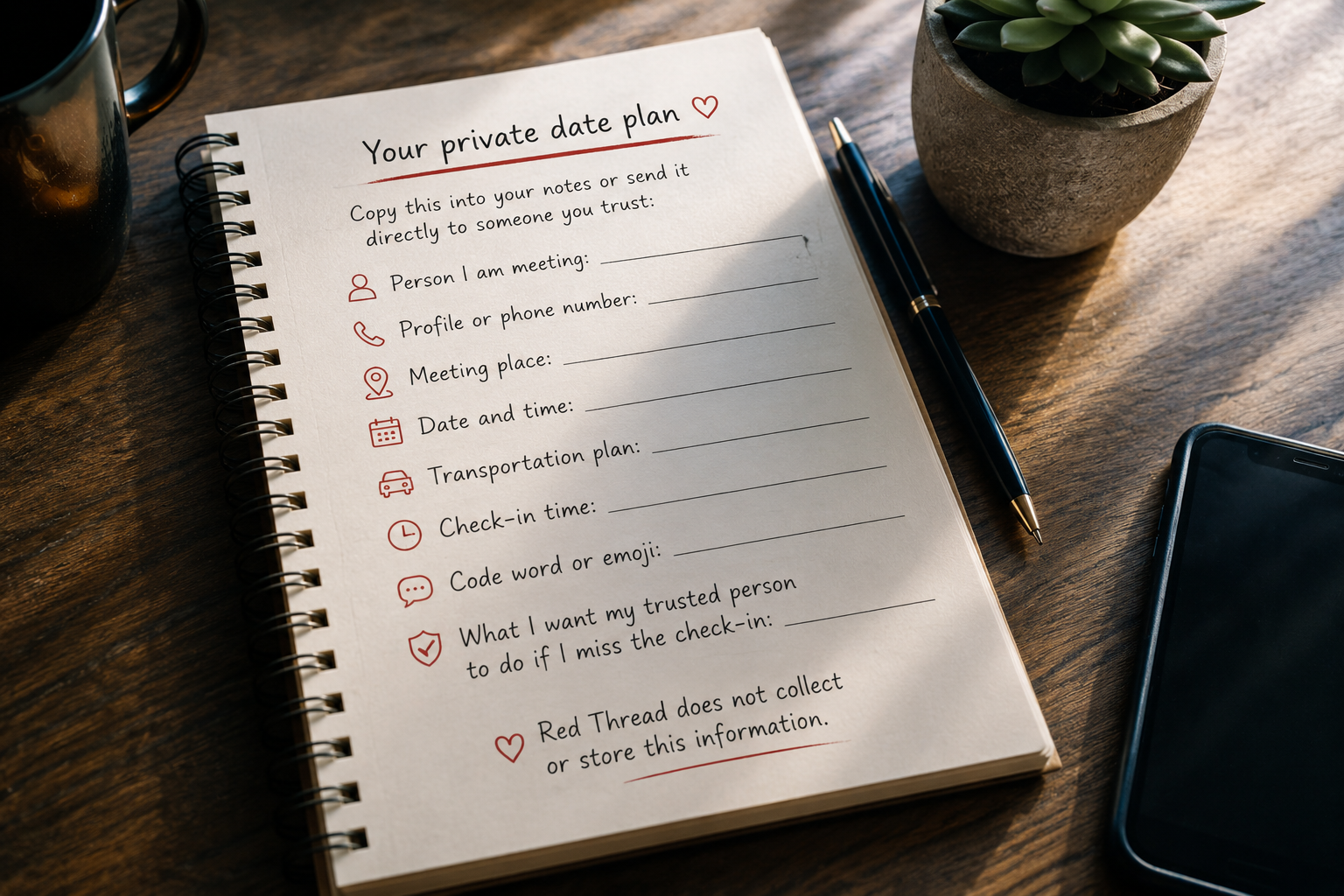
Your private date plan
Copy this into your notes or send it directly to someone you trust ⬇
Person I am meeting:
Profile or phone number:
Meeting place:
Date and time:
Transportation plan:
Check-in time:
Code word or emoji:
What I want my trusted person to do if I miss the check-in:
Red Thread does not collect or store this information.
Remember: A video call, verified profile, mutual friend, or long conversation does not guarantee that someone is safe. Preparation is not paranoia. You are allowed to change your mind at any time.
Awkward Is Not the Same as Unsafe
Awkward Is Not the Same as Unsafe
WARNING SIGNS
Dating can be awkward. People get nervous, misunderstand each other, talk too much, or say something clumsy.
The difference is what happens when you express a boundary. A safe person may feel disappointed, but they respect your answer. An unsafe person treats your boundary as something to defeat.
Warning signs to take seriously
Watch for patterns such as:
Ignoring or arguing with your “no”
Pressuring you for sex, photos, money, passwords, or personal information
Becoming intensely possessive or jealous very quickly
Demanding constant replies or proof of your location
Showing up without being invited
Trying to isolate you from friends or family
Insulting you and calling it humour
Blaming every former partner while accepting no responsibility
Rushing commitment, cohabitation, pregnancy, finances, or dependency
Controlling transportation, money, medication, clothing, food, or communication
Threatening you, themselves, your children, your friends, or your pets
Monitoring your phone, accounts, vehicle, or home
Punishing you for spending time with other people
Making you afraid to disagree
Refusing to accept that the relationship or conversation is over
One uncomfortable moment does not always reveal an abusive person. However, a repeated pattern of pressure, fear, punishment, monitoring, or control definitely deserves attention.
-
Consent means everyone involved voluntarily agrees to the specific sexual activity happening at that time.
Consent must remain present throughout the activity.
You can change your mind.
You can stop after saying yes.
Agreeing to one activity does not mean agreeing to another.
Past consent does not create future consent.
Dating someone, marrying someone, accepting a gift, going into their home, drinking alcohol, flirting, or wearing certain clothing does not remove your right to say no.
Silence, freezing, fear, submission, sleep, unconsciousness, threats, coercion, or pressure are not consent.
-
You do not owe anyone a debate before leaving.
You can:
Go directly to staff, security, or another group of people.
Call or message your check-in person.
Ask someone to stay with you while you arrange transportation.
Tell staff clearly that you do not feel safe.
Leave belongings behind if retrieving them would put you at greater risk.
Call emergency services if you are being threatened, followed, confined, assaulted, or prevented from leaving.
You do not need to protect someone else’s feelings while they are ignoring your safety.
-
You are not required to end every relationship face-to-face.
A public breakup is not automatically safer.
A private breakup is not automatically more respectful.
Choose the method that gives you the most control and the safest exit.
Depending on the situation, this may mean:
Ending contact by text or phone
Having another person nearby
Meeting in a public place with your own transportation
Avoiding being alone with them
Changing passwords and account recovery information
Turning off location sharing
Informing trusted people, neighbours, work, school, or building security
Returning belongings through another person
Blocking accounts after saving important evidence
Speaking with a shelter, crisis worker, legal clinic, victim service, or police about safety options
Do not announce every safety step you are taking. You are allowed to prepare quietly.
-
Repeated unwanted calls, messages, gifts, following, tracking, surveillance, threats, or appearances at your home or workplace are not romantic persistence.
They may be stalking or criminal harassment.
Preserve information safely
When it is safe to do so:
Save messages, emails, call logs, voicemails, usernames, and profile links.
Take screenshots that include dates and times.
Photograph unwanted gifts, damage, or notes.
Write down incidents while the details are fresh.
Keep copies somewhere the person cannot access.
Tell a trusted person what is happening.
Avoid deleting everything before considering whether it may be needed as evidence.
Do not place yourself in danger to collect evidence. Your immediate safety comes first.
-
Sharing an intimate image does not mean consenting to have it distributed.
Threatening, pressuring, humiliating, blackmailing, or controlling someone with sexual images is abuse.
If someone has shared or threatened to share an intimate image:
Save evidence of the threat or distribution when safe.
Report the account or content to the platform.
Do not pay blackmail demands.
Tell a trusted person.
Contact police, victim services, a sexual-violence service, or a legal clinic for information about your options.
This is not your shame to carry.